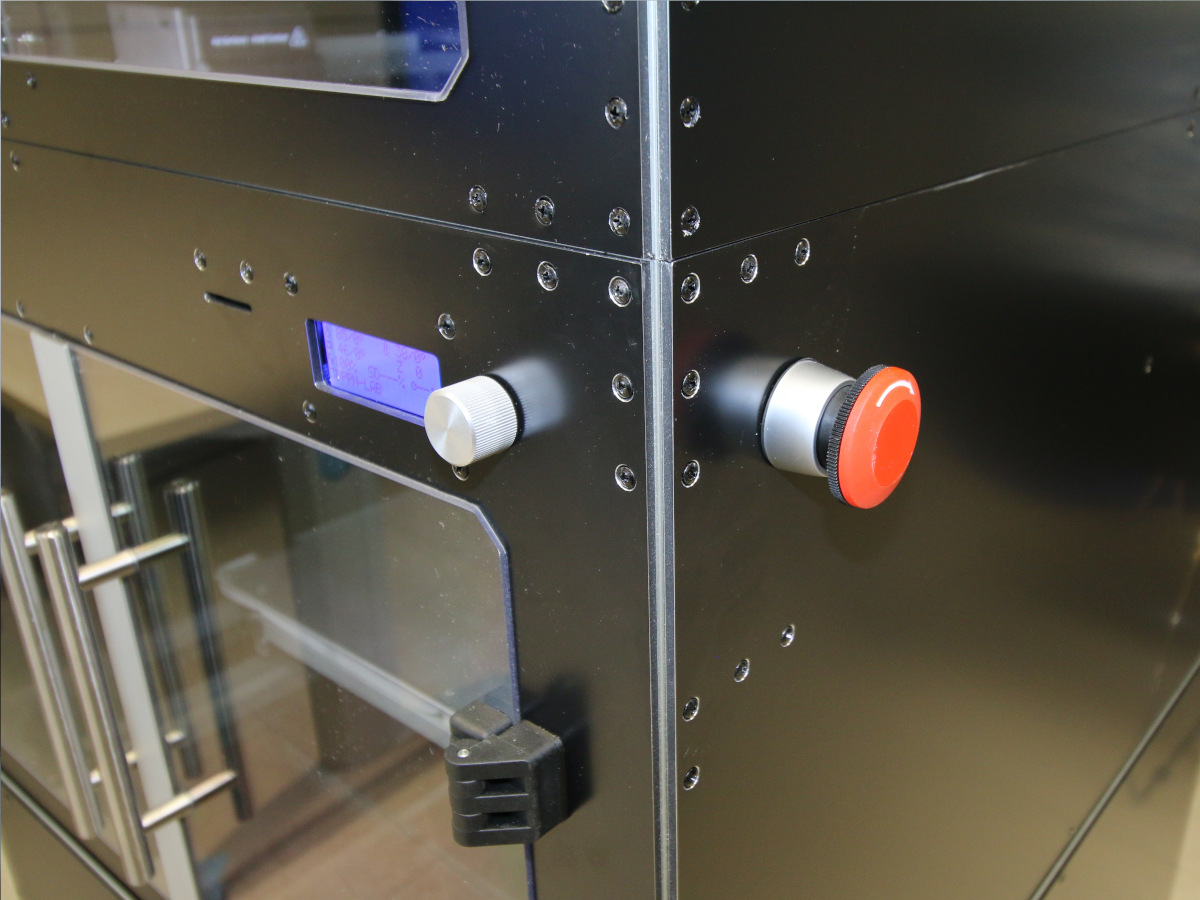
Large-format 3D printing is transforming the way many companies develop prototypes, functional parts, technical models, and components for various industrial sectors. The ability to produce large objects directly using additive manufacturing technologies allows companies to tackle projects that, until recently, required lengthy processes, numerous assembly operations, and significant investments in equipment.
In industrial prototyping , reducing the time between design and the production of a physical component can make a significant difference. A full-scale prototype, created with 3D printing, can be used to verify proportions, analyze ergonomics, validate an assembly, or identify necessary modifications before moving on to the final production phase.
In addition to accelerating development, large-scale additive manufacturing can help control costs associated with the prototyping process. The creation of specific molds, specific machining operations, and tool preparation can account for a significant portion of a project’s budget. 3D printing offers a particularly attractive alternative for the production of one-off parts or small batches.
What is large-scale 3D printing?
Large-scale 3D printing refers to the additive manufacturing of objects that exceed the typical dimensions of conventional 3D printers. The concept can be applied to industrial prototypes, structures, housings, design models, technical components, and other large items.
Rather than focusing solely on printer size, it’s important to consider the entire manufacturing process. The choice of technology, material, resolution, part orientation, and production strategy directly influence the final result.
In some projects, a large part can be produced in a single operation . In other cases, it may be more convenient to divide the model into several sections and join them together later. This second option allows you to work with objects that even exceed the available volume in the production area, while maintaining a high level of flexibility.
Reducing time as a strategic advantage
One of the main advantages of additive manufacturing is the ability to move from the digital model to the physical prototype with fewer intermediate steps.
In a traditional process, creating a prototype may require the preparation of tools, molds, machining programs, finishing operations, and various assembly steps. Each of these steps can increase the time required to produce the first part.
Thanks to 3D printing, the workflow can be significantly simplified. Once the digital file is prepared and validated, production can begin immediately, depending on the project’s specifics.
This speed becomes even more important when the project is in the development phase. If, after a test, the geometry needs to be modified, the new digital model can be prepared for a second production run without necessarily having to redo the entire tooling system.
For this reason, rapid prototyping via 3D printing is particularly useful in processes where several iterations are performed before arriving at the final design.
How to reduce the costs of industrial prototyping
Reducing costs doesn’t depend solely on the price of a 3D print. The total cost of the production process must also be considered .
Factors that may have an influence include:
- Elimination or reduction of specific molds and equipment.
- Fewer operations are required to obtain certain geometries.
- Possibility of creating unique prototypes without having to set up a complete production line.
- Reduction of development times and related working hours.
- Less material waste than some subtractive processes.
- Ease of making design changes between iterations.
- Ability to produce complex components that would be difficult or expensive with conventional methods.
The real savings therefore emerge when analyzing the entire development cycle, and not just the production cost of the single component.
Materials and technologies for large format printing
Material selection is crucial to achieving a successful prototype. In large-format 3D printing, different families of materials can be used depending on the project’s mechanical, thermal, dimensional, and aesthetic requirements.
For some prototypes, thermoplastic materials designed to produce lightweight models of considerable size may be sufficient. For more demanding applications, reinforced materials or solutions specifically designed to withstand certain stresses may be chosen.
The technology used also influences the result. There are various additive manufacturing systems , each with its own characteristics in terms of precision, speed, production volume, compatible materials, and surface finish.
Therefore, before starting a large-scale project, it is advisable to evaluate the component characteristics and define which properties are actually a priority.
Large prototypes made in a single piece
One of the most exciting possibilities offered by large-format technologies is the production of large components in a single manufacturing operation .
This can be particularly useful for models designed to verify overall dimensions, complex shapes, or the integration of different components. Avoiding certain joints reduces subsequent work and facilitates the evaluation of the prototype as a whole.
However, producing a large component in a single step requires careful consideration of aspects such as deformation, manufacturing stability, model orientation, and working conditions.
When the size is too large, splitting the model can be a more efficient alternative.
Modular production to overcome dimensional limits
Modular manufacturing allows you to break a large model into multiple parts. Each section can be printed separately and then assembled.
This procedure offers great design flexibility . It also allows you to optimize the orientation of each component and adapt production to the available dimensions.
Joining areas must be designed from the outset to ensure proper integration. Depending on the application, mechanical systems, adhesives, or other assembly solutions may be used.
Modular manufacturing can also facilitate the transport and handling of large prototypes.
The role of digital design in additive manufacturing
The quality of the final result begins even before printing. A properly prepared digital model is essential to fully exploit the benefits of industrial 3D printing .
During the preparation phase, you can analyze thicknesses, tolerances, joins, orientation, and potential problem areas. You can also adjust the geometry to reduce material or improve the strength of specific areas.
In this context, designing for additive manufacturing enables the development of components that take into account the specific capabilities of the technology right from the start.
A properly designed geometry can reduce production times, optimize material consumption and simplify subsequent operations.
Why is 3D printing interesting for industry?
The industry increasingly requires flexibility , speed, and the ability to respond to customized projects. Traditional manufacturing remains essential for many processes, but additive manufacturing can occupy a strategic position when prototypes, small series, or components with special geometries are required.
The ability to quickly modify a digital file allows you to respond to changing project requirements without necessarily having to transform your entire production infrastructure.
Furthermore, the production of large components can be particularly interesting in sectors where prototypes are considerable in size and must be validated before investing in definitive solutions.
3DPRN and large-scale 3D printing
In the field of professional additive manufacturing solutions, 3DPRN is linked to the development of technologies also oriented towards large-format 3D printing .
Choosing the most suitable solution should always begin with the specific needs of the project. The size of the part, the required material, the level of precision, the time available, and the prototype’s characteristics are all factors that must be analyzed before selecting a technology.
The goal is not simply to produce a larger component, but to find a process that offers an appropriate balance between cost, speed, accuracy and functionality .
A tool to accelerate product development
Producing large-scale prototypes using 3D printing can be an important tool for shortening development cycles. The ability to quickly produce a first physical version allows you to identify issues that aren’t always obvious on-screen.
A prototype can be used to test:
- Dimensions and proportions .
- Integration between different components.
- Accessibility and ergonomics.
- Positioning of elements and mounting systems.
- Interference between the parties.
- Design of surfaces and shapes.
- Feasibility of certain concepts.
- Need for changes before final production.
Each iteration can provide additional insights and help improve the final product.
Industrial prototyping for more flexible processes
The evolution of large-format 3D printing is linked to a broader transformation of industrial processes. Additive manufacturing allows for the combination of digital design, flexible manufacturing, and customized production within a single workflow.
For companies, this means having a tool that can adapt to different needs without always relying on rigid production processes. For prototyping, the advantage is particularly clear: an idea can be transformed into a large physical object in fewer steps and with greater scope for modification.
The result is a development process in which time, costs and flexibility take on central importance.
Large-scale 3D printing offers a significant opportunity to reduce the time and cost of industrial prototyping. Its ability to produce large models and components, both in a single piece and using modular systems, enables projects that require speed and flexibility.
The ability to work directly from a digital file, make changes between iterations, and avoid some traditional steps makes additive manufacturing an increasingly attractive tool for industrial development.
When combined with proper model preparation, appropriate material and technology selection, and precise process planning, large-format 3D printing can become a strategic tool for developing products more quickly, flexibly, and efficiently.


